Krivid(YA) at glance

About Krivid(YA)
Our Philosophy
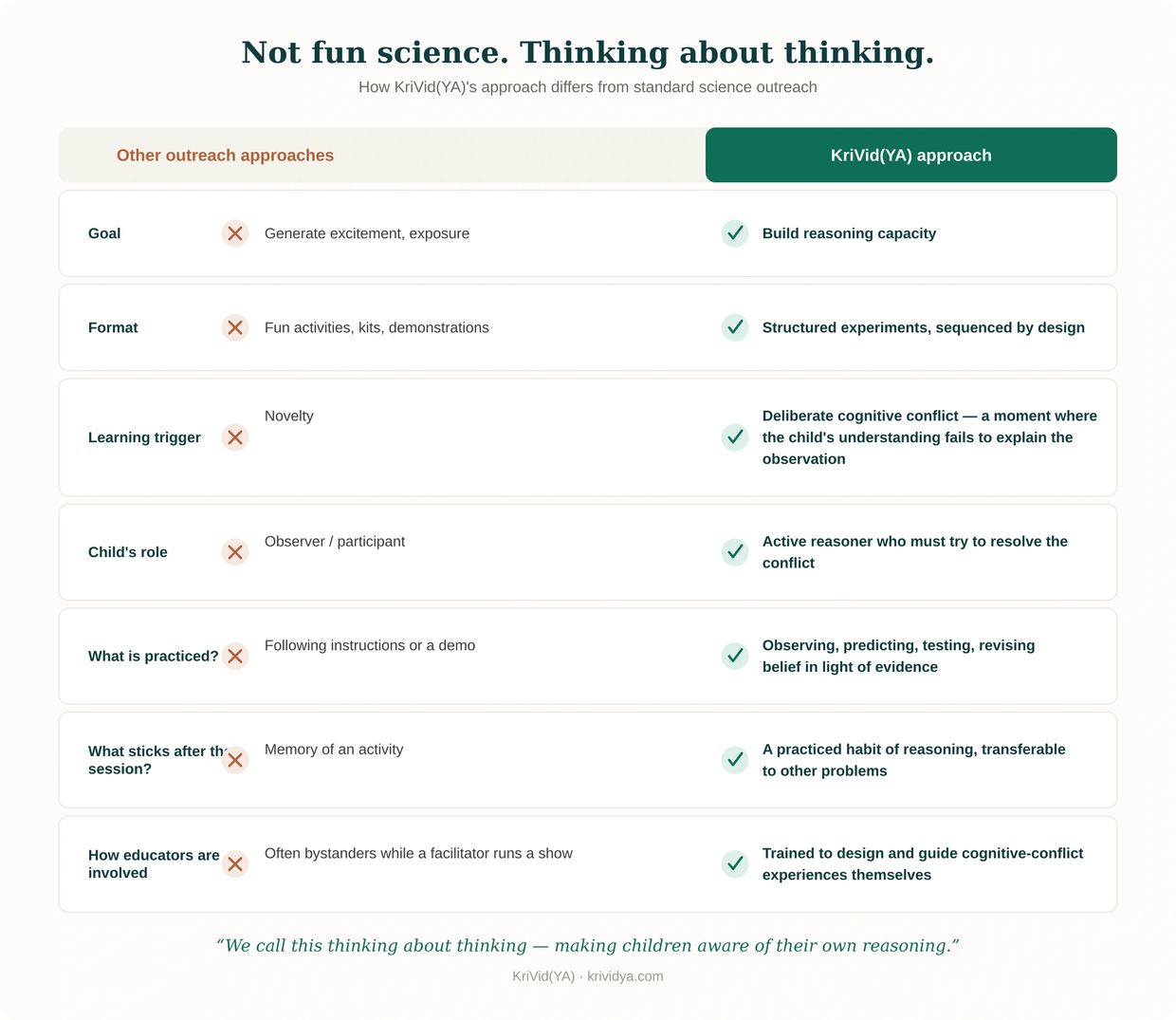
While most science outreach optimizes for engagement, KriVid(YA) optimizes for reasoning — using structured experimentation to help students think about thinking, thus finding the fun in science rather than seeking fun science.
Who is it for?
Designed for primary- and middle- school children and the educators who teach them — delivered through schools, NGOs, and CSR-funded education programs seeking measurable improvement in scientific reasoning, not just science exposure.
Why it's different?
Most science outreach — robotics kits, science fairs, one-off "fun experiments" — is built to generate excitement. Excitement fades once the kit is packed away. KriVid(YA)'s pedagogy is built on a different sequence: children observe a phenomenon, form an initial understanding of it, and are then deliberately walked into a cognitive conflict — a carefully designed moment where their existing understanding fails to explain what they're seeing. Resolving that conflict, through further experimentation and reasoning rather than being told the answer, is where the actual learning happens.
This is a purposeful pedagogical design choice, not an accident of curiosity. Every experiment is built to first let a misconception surface, then force the child to reason their way out of it. The result isn't a child who remembers a fact — it's a child who has practiced the process of updating their own thinking when evidence contradicts it. We call this "thinking about thinking": making children aware of their own reasoning, not just the content of the science.
Engagement models

Beyond the classroom

THUG day
Children who complete the program often stay in the same school, and many kept returning simply to see their mentor. THUG Day started as a response to that — a standing Thursday tradition where children, past and present, come to greet their mentor and each other. It's become a small but consistent marker of the program's continuity beyond the formal coursework.

Everyday(s) Heroes: women in STEM
A lecture series introducing children to women in professional roles beyond the familiar ones of mother and teacher. Close to 10 speakers took part in 2021, each sharing their own career path, with the aim of expanding what children — particularly girls — see as possible for themselves.